

The Office Conversion Pipeline Is No Longer a Zoning Problem
New York City has spent the last three years aggressively repositioning office-to-residential conversions as a centerpiece of its housing strategy.
First came the policy changes.
In December 2024, the City Council approved the City of Yes for Housing Opportunity initiative by a 31-to-20 vote, dramatically expanding the universe of office buildings eligible for residential conversion under Article I, Chapter 5 of the Zoning Resolution. Buildings constructed as recently as December 31, 1990, became eligible citywide under revised ZR 15-00 provisions. But a few months earlier, Albany enacted Real Property Tax Law §467-m, effectively replacing the expired 421-g program with a long-term tax abatement designed specifically to make office conversions financially viable.
Then, fast-forward to 2026: a new layer was added.
In early 2026, the City Council introduced “Introduction 0178-2026”, proposing an Office of Conversion Assistance that would coordinate among the Department of Buildings, Department of City Planning, HPD, and the Landmarks Preservation Commission.
Put all these together, and the message from the city becomes clear. New York wants its underperforming office stock repositioned into housing, and it wants that process accelerated.
But the problem now is that the city keeps treating office conversion as a policy problem when it is fundamentally a geometry problem. That distinction matters because zoning can be amended, taxes can be incentivized, and bureaucratic coordination can be streamlined, but a 40ft-deep interior building core cannot magically become a legal bedroom simply because City Hall wants more housing units.
And that is where the conversation about conversions starts to become disconnected from physical reality.
The Real Bottleneck Is Hidden Inside the Floor Plate
The public narrative around office conversions is deceptively simple.
Most of the buildings New York wants to convert are often the least compatible with residential occupancy. That’s the real contradiction sitting at the center of the entire conversion pipeline.
According to the recent CBRE Manhattan office market data report, office demand has collapsed while Manhattan vacancy climbed above 22%. Therefore, empty offices should become apartments.
On paper, the swap looks straightforward: idle office floors meet a housing shortage, and the math practically writes itself. But in practice, office buildings and residential buildings are two fundamentally different physical products, engineered around incompatible logics that no spreadsheet can reconcile.
A modern office tower (e.g., the Seagram Building) is usually designed around density, centralized mechanical systems, large, uninterrupted floor plates, and deep interior workspace.
Residential buildings, on the other hand, operate under an entirely different logic. Bedrooms require legal windows, and habitable rooms require light and air. Residential corridors face stricter egress limitations. Every apartment needs its own kitchen and bathroom; plumbing density increases dramatically.
In other words, converting office space into housing is not like changing tenants inside a building. It’s like trying to convert an ocean liner into an airplane: you may salvage the materials, but the structure, propulsion, and life-support systems all have to be re-engineered from scratch.
ZR 15-00 Changed the Rules, Not the Physics
At the heart of this section sits Article I, Chapter 5 of the Zoning Resolution, better known as ZR 15-00, which was specifically designed to create relief for older non-residential buildings converting into residential use. Without it, most Manhattan office towers would never qualify because they exceed residential bulk rules, lot coverage limitations, and open-space requirements.
Most people discussing office conversions have never even heard of “ZR 15-00,” yet this single section of the Zoning Resolution quietly determines whether many conversion projects live or die.
The recent City of Yes amendments significantly expanded eligibility. Buildings constructed before December 31, 1990, can now qualify in many commercial districts citywide.
Politically, this was framed as removing barriers. But technically, it was more like widening the entrance to a tunnel whose biggest obstruction still sits further inside.
Because while ZR 15-00 relaxes certain zoning constraints, it does not override the Multiple Dwelling Law, the Housing Maintenance Code, or core life-safety requirements embedded in the Building Code.
That distinction is everything.
The city can reduce the required court dimensions under conversion rules. In some cases, legally required windows may now operate with as little as 15ft of clearance rather than the roughly 30ft required for new construction. That is an extraordinary concession.
New York is essentially compressing spatial tolerances to make conversions physically survivable. Yet the underlying residential habitability rules remain intact.
Under New York’s Multiple Dwelling Law, habitable rooms still require legal light and air exposure. Housing Maintenance Code provisions still require a window area of at least 10% of the habitable floor area, with 5% operable. Building Code Chapter 10 still governs residential egress travel distances, the maximum distance an apartment door can be from a protected fire stair, and dead-end corridor limitations. These are life-safety thresholds, not elevator-convenience rules, and they exist precisely because residents sleep in the building, whereas office workers do not.
Those rules do not disappear simply because the city wants more apartments. The honest path forward is to stop treating every empty tower as a candidate for conversion and start screening for physical feasibility first: which floor plates can actually accommodate light, air, and egress, and which ones never will, no matter how generous the zoning becomes.
The “Dark Space” Problem Nobody Can Legislate Away
The office towers driving Manhattan’s vacancy crisis were largely constructed between the 1960s and 1990s. Unfortunately, those same buildings were designed around exactly the conditions residential occupancy struggles with most.
They have large centralized cores and deep floor plates that often exceed 25,000 square feet. Some older buildings also have sealed curtain wall systems and centralized HVAC infrastructure optimized for office occupancy.
Consider what that means for residential conversion. A typical 1970s office tower might place its elevator core 40 or 50 feet from the nearest window line, leaving a massive band of windowless interior space around it. For cubicles and conference rooms, that depth is harmless. But for apartments, it is fatal: Section 1205 requires every legal bedroom to draw natural light and ventilation from an exterior window, and a bedroom buried 40 feet inside the floor plate simply cannot.
This is what some NYC architects now call the “dark space” problem, and it is quietly becoming the single biggest predictor of whether an office tower can be reborn as housing or whether it will sit, half-empty, for the rest of its useful life.
The interior square footage technically exists, but large portions cannot legally function as habitable residential space. And this breaks down the economics quickly because those deep interior zones still cost money to acquire, demolish, reinforce, heat, cool, and maintain, even if they cannot legally generate residential revenue.
That is where the conversion story becomes far more expensive than most headlines suggest.
What “25 Water Street” Really Reveals About NYC Conversions
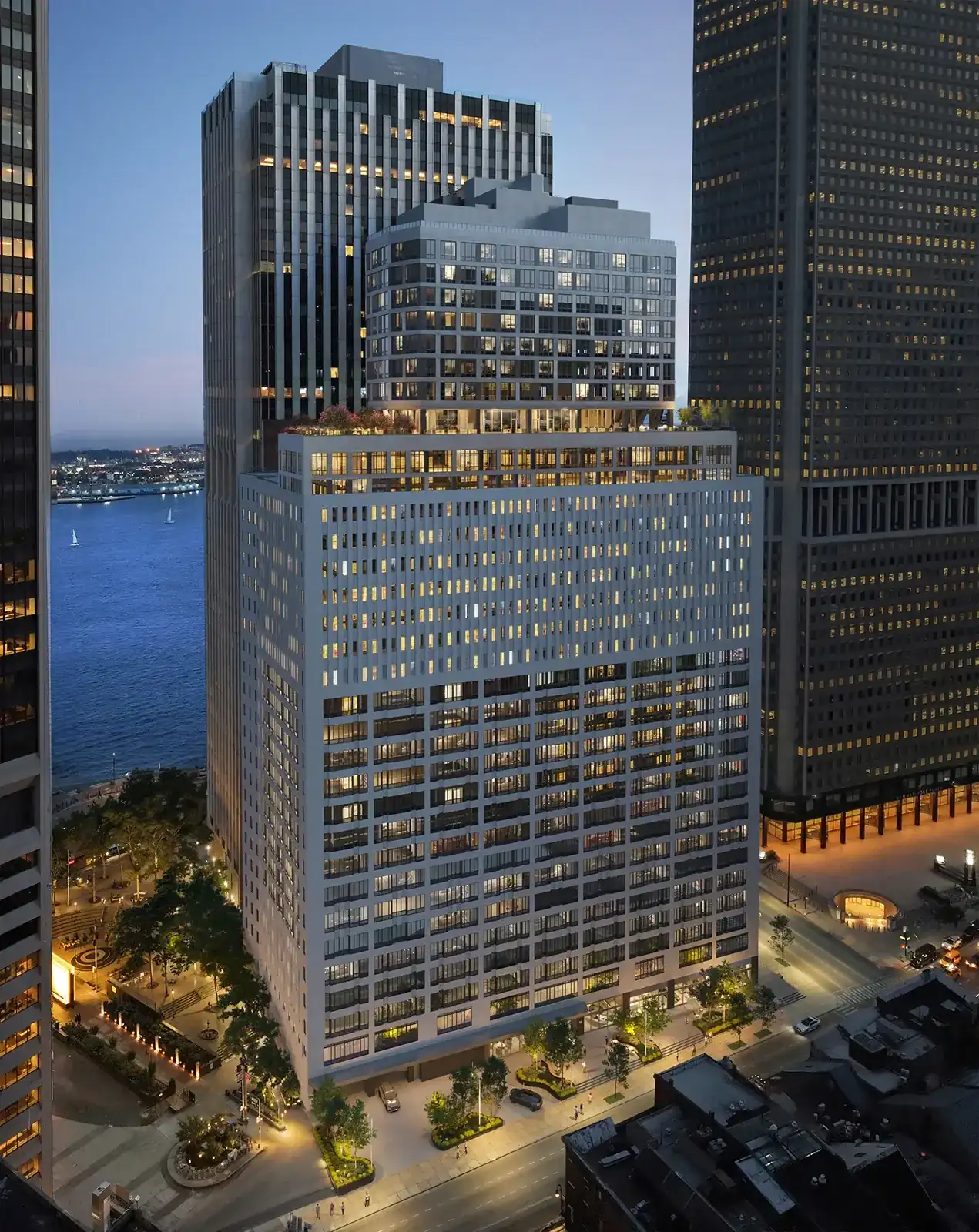
As of today, the most notable office conversion project in America is currently 25 Water Street, formerly known as 4 New York Plaza.
The project, led by GFP Real Estate, Metro Loft Management, and Rockwood Capital, transformed a roughly 1.1-million-square-foot office tower into approximately 1,320 residential units, making it the largest office-to-residential conversion in U.S. history by unit count.
What matters here is not the headline but the engineering intervention that made the building legally habitable.
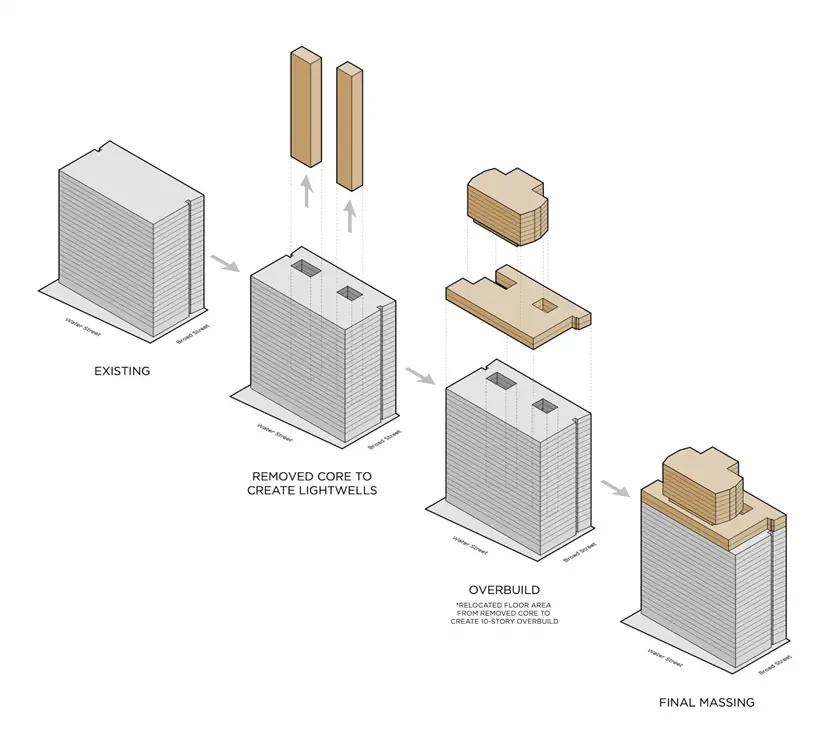
The original floor plates were so deep that conventional apartment layouts could not satisfy residential light-and-air requirements.
To solve this, the design team carved a vertical light slot through the center of the building, creating an interior court that allowed habitable rooms to meet legal window-exposure requirements.
The 25 Water Street project also required: major facade modifications to introduce operable windows, extensive plumbing riser installations through existing slabs, and highly irregular apartment layouts designed around legal light access. The bathrooms, closets, kitchens, and circulation spaces were pushed deep into the floor plate, while sleeping areas radiated outward toward windows in a complex pinwheel configuration.
Taken together, the scale of that intervention is hard to overstate: developers were not merely renovating interiors but cutting massive voids through an existing structural frame simply to create legal bedrooms. This is not adaptive reuse in the casual sense people often imagine. It is a massive structural reconstruction disguised as a conversion.
This kind of “economics” only closed because several conditions aligned simultaneously.
The building sat in Lower Manhattan, where acquisition pricing had already collapsed relative to pre-pandemic values. The project qualified for major tax incentives under 467-m. And the residential rental assumptions remained strong enough to justify extraordinary construction costs.
Remove any one of those conditions, and the deal becomes significantly harder to justify. This is why office conversion headlines can be misleading. People see successful projects and assume the model scales broadly. But it does not.
Projects like this 25 Water Street conversion only work because they exist inside an unusually narrow intersection of geometry, pricing, tax policy, and financing conditions.
Why Pre-War Towers Keep Outperforming Modern Offices
Most people assume newer buildings in NYC should adapt more easily because they are technologically modern.
But the opposite is often true.
A CBC study found that 90% of the older pre-war (before 1945) buildings in New York are significantly easier to convert than newer post-war office towers.
Buildings like 70 Pine Street, originally completed in 1932, were designed long before centralized air conditioning and sealed curtain walls existed. They relied heavily on operable windows, narrower floor plates, and multiple exterior exposures for natural light and ventilation.
In other words, many older office towers already share core DNA with residential buildings.
By contrast, post-war office towers optimized aggressively for commercial efficiency. The floor plates became larger, the cores became deeper, the mechanical systems became centralized, and the facades became sealed.
All of those choices improved office functionality while simultaneously making future residential conversion more difficult.
This is why many modern Class B and Class C office buildings now sit in a strange limbo, tagged the “Urban Doom Loop”. They still draw tenants on the low end of the market, yet they are losing competitive ground to newer trophy towers and remain physically and economically resistant to residential reuse.
That is a brutal combination in a city desperately searching for housing supply.
The Building Code Has Become the Real Constraint
For years, the industry correctly identified zoning and taxes as the primary barriers to conversion. That logic made sense at the time.
The old ZR 15-00 cutoff excluded much of the post-war office inventory, and the expiration of 421-g removed one of the few meaningful financial incentives available for adaptive reuse. All those barriers have now been substantially reduced, as confirmed by an official NYC Office Adaptive Reuse Study.
So, this means the bottleneck has to be increasingly embedded in the building code itself.
Residential egress standards under NYC Building Code Chapter 10 frequently require additional stairs in buildings originally designed around office occupancy. NYC Energy Conservation Code requirements necessitate major facade replacements because older curtain wall systems fail to meet modern residential energy standards. Plumbing density requirements create expensive slab coring operations throughout entire towers.
These are clearly not political problems; they are physical constraints. And such physical constraints are remarkably stubborn.
A zoning amendment can be passed in months. A tax incentive can be approved through legislation. But no policy initiative can retroactively redesign a 1978 office tower’s structural core.
That is why former Mayor Eric Adams’ proposed Office of Conversion Assistance/Accelerator is being misunderstood in some corners of the industry, even though it is useful to an extent.
Coordination across agencies matters, faster approvals matter, and clear communication between departments absolutely matters because delays in New York City development can quickly compound into serious financial exposure.
However, a coordination office cannot waive Multiple Dwelling Law habitability requirements. It cannot override egress provisions rooted in life-safety standards. And it certainly cannot reduce the structural cost of carving new light wells through 30 floors of concrete.
The Office of Conversion Assistance may accelerate projects that are already penciled. But it will not rescue projects whose geometry fundamentally does not work.
Which Conversion Projects Will Actually Work
Make no mistake, the current boom is real. Since the passage of the “City of Yes” zoning updates and the implementation of RPTL § 467-m, New York has seen its largest wave of office-to-residential filings in decades, with conversion announcements stacking up across Lower Manhattan and Midtown South.
But the next phase of this boom will not be determined primarily by political momentum. It will be determined by which sponsors correctly understand the difference between zoning flexibility and physical feasibility early enough in the underwriting process.
That distinction is becoming enormously expensive.
The projects succeeding today (like 25 Water Street) are not succeeding because they found regulatory loopholes. They are succeeding because their teams identified buildings whose geometry, structural systems, acquisition basis, and tax position could realistically survive residential conversion.
Everyone else discovers the problem later, deeper into design development, after debt has already been incurred and assumptions have hardened into commitments.
That is where projects become trapped.
And in New York City, conversion projects rarely fail all at once.
More often, they slowly bleed value through redesigns, stalled approvals, shrinking unit counts, escalating construction scopes, and financing assumptions that no longer hold together once the building is tested against residential reality.
Zoning can be rewritten in a single Council vote. Tax law can be redrawn in a single legislative session. But concrete, columns, and core depth answer to a slower authority: the laws of physics. And that authority is what will quietly decide how much of New York’s next housing supply actually gets built.
So, the conversion boom is real. But physics operates on a far older set of rules, and it does not negotiate.